The Quiet Rebranding of China’s Global Talent Pipeline
Blog
STRIDER
For more than a decade, the Thousand Talents Program (TTP) was one of the People’s Republic of China’s (PRC) largest and most successful mechanisms for attracting overseas scientific and technical expertise. It targeted the world’s top researchers, scientists, and experts, incentivizing them to work in the PRC through competitive compensation, funding, and institutional support. Public reporting estimates that more than 7,000 individuals participated in the program from 2008 to 2018, providing a significant boost to Beijing’s science and technology sectors.
Then, after years of prominence, the program appeared to vanish.
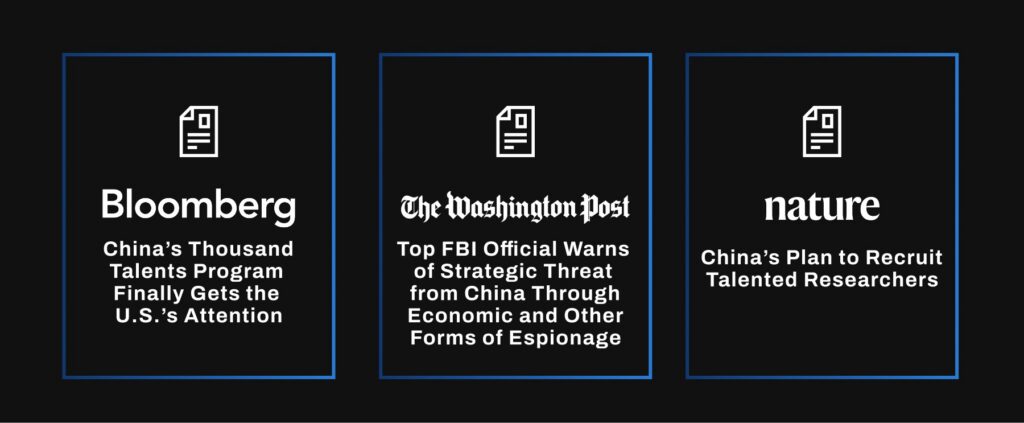
As major Western news outlets began to highlight the risks of intellectual property theft linked to talent recruitment by the PRC, references to the TTP disappeared from official PRC government websites and public-facing recruitment materials. PRC officials told foreign governments and institutions that the program had been discontinued. Even the words “Thousand Talents Program” were discouraged from being used in written correspondence by the PRC. To outsiders—and competing nations—it looked as though the program had run its course.
As references to the TTP declined, Strider analysts observed a corresponding increase in the activity of other talent programs operating under different names. In many cases, the eligibility requirements and incentives for these programs were similar to those offered under the TTP. They targeted the same types of researchers, scientists, and experts from abroad and continued to channel that talent into the PRC’s scientific and technological pipelines.
Eventually, the evidence pointed to a different conclusion: the Thousand Talents Program—perhaps the PRC’s most effective state-sponsored talent recruitment program to date—was never eliminated. It was rebranded, reorganized, and better positioned to influence the next phase of the PRC’s global talent strategy.
The Rise and Fall of the Thousand Talents Program
The Thousand Talents Program (also known as the Thousand Talents Plan) was one of hundreds of talent plans designed to systematically draw advanced scientific and technical expertise to the PRC at scale. It operated as a centralized framework through which universities, research organizations, state laboratories, and companies could recruit foreign talent and align it with PRC priorities.
From its inception, the program was embedded within the Chinese Communist Party’s (CCP) broader political and organizational architecture. According to the plan’s now-defunct website, the United Front Work Department (UFWD) was one of the authorities responsible for implementing the TTP. The UFWD is a decades-old agency responsible for managing the CCP’s influence operations and advancing its interests inside and outside the PRC. President Xi Jinping has described it as “an important magic weapon for the party to defeat the enemy.”
The United States government has framed the program in similarly strategic terms. In 2020, the U.S. Department of Justice described the TTP as “one of the most prominent Chinese talent recruitment plans that [is] designed to attract, recruit, and cultivate high-level scientific talent in furtherance of China’s scientific development, economic prosperity, and national security.”
Over time, the program expanded into a set of distinct branches designed to target different career stages and use cases. These included long-term tracks for researchers, short-term arrangements that allowed overseas experts to retain foreign affiliations, entrepreneurial tracks linked to commercialization, and the Young Thousand Talents Program, which focused on early- and mid-career researchers trained abroad.
That scale and visibility, however, created exposure.
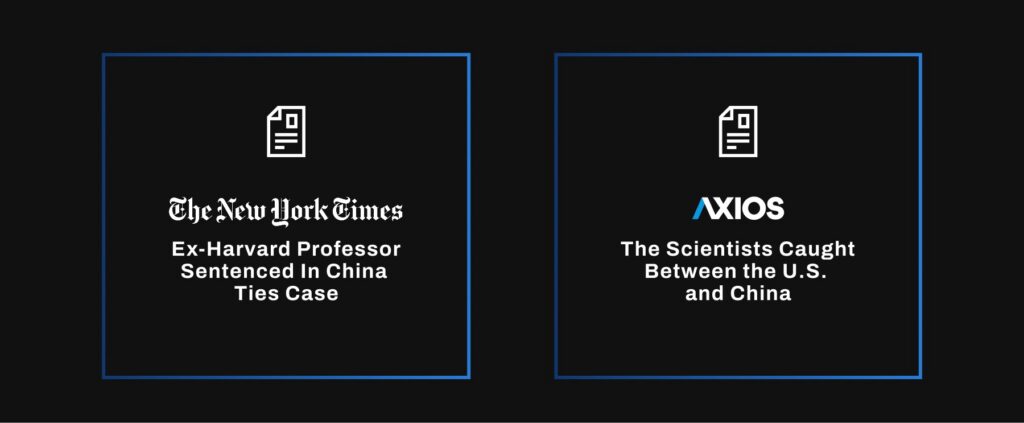
As international scrutiny intensified and U.S. enforcement actions increasingly cited the Thousand Talents Program by name, the branding that had once amplified the program’s reach became a liability. Some individuals affiliated with the TTP became targets of FBI investigations aimed at curbing the transfer of sensitive technology and intellectual property to the PRC. As a result, the program became closely associated with enforcement and counterintelligence concerns in the United States and across the West.
A Strategic Rebrand and Reorganization
By the early 2020s, the PRC’s national talent recruitment architecture began to shift in visible ways.
Chinese-language recruitment forums and open-source reporting indicate that in 2021, the Thousand Talents Program was rebranded under a new name: the Qiming Program. Overseen by the PRC’s Ministry of Industry and Information Technology, Qiming seeks technological experts in industries of strategic importance, such as semiconductors.
The timing and structure of the change are notable.
The rise of Qiming closely tracked the decline of Thousand Talents references on the open web. Eligibility requirements for participation in Qiming closely mirrored those previously associated with the Thousand Talents Program, indicating continuity in how candidates were targeted and selected. Qiming’s financial incentives—which include lucrative one-time awards from central and local governments—are identical to provisions in the original TTP. The end goal also remained consistent: recruiting overseas talent to advance the PRC’s strategic scientific and technological dominance. Taken together, these signals suggest that Qiming functions as an alias for, if not the direct replacement of, the TTP.
Qiming and other national-level talent introduction programs are only part of the PRC’s sustained, whole-of-nation approach to recruiting foreign talent. Even as individual programs change names or structures, talent recruitment activity remains a top priority for the PRC—and an essential consideration for organizations seeking to safeguard their people, technology, and innovation from economic statecraft.
From Indicators to Actionable Intelligence
Strider helps organizations address this challenge by enabling a more comprehensive view of the PRC’s talent recruitment ecosystem.
Tools like Shield help organizations protect intellectual property by identifying higher-risk indicators—such as specific email addresses, affiliated domains, and keywords in multiple languages—commonly associated with state-linked recruitment and technology transfer activity. Other tools, such as People Search and Insights, help illuminate individuals’ involvement in state-sponsored talent programs. Meanwhile, Organizations Search can uncover organizations involved in state-directed recruitment efforts. Alongside this data-driven approach, Strider provides ongoing analysis within its Intelligence Center of recruitment trends, institutional linkages, and talent movement—offering additional context on how state-sponsored efforts are evolving in real time.
Conclusion
The evolution of the Thousand Talents Program demonstrates how the PRC rebrands and reorganizes major initiatives to sustain talent recruitment under external pressure. Looking ahead, the most consequential developments are unlikely to announce themselves. Instead, they will emerge through updated programs, new structures, and familiar patterns in unfamiliar places. As a result, the advantage will belong to organizations that can leverage cutting-edge intelligence to identify, assess, and act on threats faster.